Temperature & CO2 move together
The temperature of the Earth’s atmosphere and the carbon dioxide level in the atmosphere have moved together for at least 800,000 years.
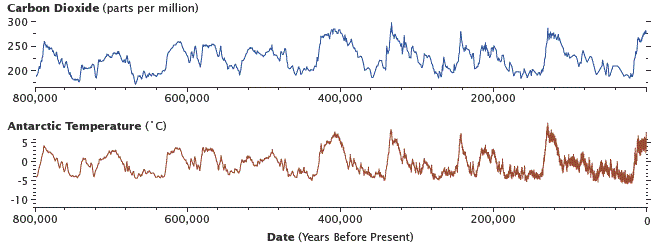
- The blue line shows the “carbon dioxide level in the atmosphere” over the 800,000 years before 1950.
- The graph’s CO2 axis ranges from 150 to 300 parts per million (ppm).
- The graph does not show the rapid rise in CO2 levels since 1950, which, as of 2026, is 428 parts per million (ppm).
- The red line shows the “Antarctic air temperature” over this same period.
The two graphs show that the temperature has been high when CO2 has been high, over the last 800,000 years. Also, when CO2 levels have been low, temperatures have been low. The temperature and carbon dioxide levels tend to move together.
Ice ages and low CO2 go together
The most recent ice age ended about 20,000 years ago. In the graph above, this ending is the lowest temperature on the far right. (The time axis explicitly shows 200,000 and 0 years before the present, and the markings on the axis show 200,000, 160,000, 120,000, 80,000, 40,000, and 0 years before the present.)
So, 20,000 years ago, the average temperature was about minus 5 °C and the CO2 level about 180 ppm. This period is an example of low temperatures occurring during periods of low carbon dioxide. During this ice age, half of North America was covered by an ice sheet up to three kilometres deep.
You can see about 10 temperature peaks over these 800,000 years. These are interglacial periods, which are brief warm intervals. For most of this period, the Earth has been in ice ages.
How scientists worked this out
Scientists went to Antarctica and drilled deep into the ice. By examining air bubbles trapped in this ice, they have seen what has happened in Antarctica over the last 800,000 years. Scientists measure the CO2 levels in these trapped air bubbles and determine how CO2 moved over this period. From these air bubbles, they can also identify the atmospheric temperatures.
A little CO2 has a big impact.
Some people may think that CO2 levels, like 300 parts per million, are so small that they cannot be influential. However, the graph shows otherwise. It shows that at 180 ppm, you have an ice age. Changes in CO2 level pack a big punch, just like a small pinch of salt can have a big influence on the taste of a meal.
John Tyndall identified the science behind this in 1863. When you increase the concentration of carbon dioxide in the atmosphere, this decreases the heat escaping from our planet into outer space, which tends to raise temperatures on our planet.
“Global temperature” and the “level of carbon dioxide in the atmosphere” tend to move together. The vast amounts of carbon dioxide released by burning fossil fuels during our industrial age have significantly increased CO2 levels, threatening to raise global temperatures substantially. The planet has begun to warm, and we need to limit this significant change.
The timing of temperature & CO2 increases
Antarctic ice-core data show that temperature increases occurred between 200 and 1000 years before the increases in CO2. Some people incorrectly argue that this means the current high levels of CO2 are not causing global heating. Here’s an explanation of how the temperature increase can occur first.
Periodic changes in the Earth’s motion around the Sun have caused periodic oscillations between ice ages and interglacial periods. As you can see in the graph above, over the last 800,000 years, the Earth has experienced a warmer interglacial period about every 100,000 years, driven by the Earth’s orbit cycling between more and less elliptical shapes. This cycle also occurs about every 100,000 years. (Milankovitch orbital cycles and their role in the Earth’s climate, NASA)
When a change in the Earth’s movement around the Sun leads to warming, various amplifying feedbacks detailed on this website can amplify this warming:
- The permafrost feedback
- The ice cover feedback
- The water vapour feedback
- The phytoplankton feedback
- The forest fire feedback
- The ice-darkening feedback
- The glacier altitude feedback
And here’s yet another feedback that can amplify warming – and show how temperature increases can occur before or after carbon dioxide increases.
The Ocean CO2 feedback

In this feedback loop:
- Increased temperatures tend to increase ocean temperatures, which
- Reduces the ocean’s ability to hold CO2, which tends to
- Increase carbon dioxide in the atmosphere, which tends to
- Increase temperatures, and then the cycle repeats.
This warming, amplifying feedback loop can become dominant in two ways:
- First, higher temperatures (top-left node) can lead to higher carbon dioxide levels (bottom-left node). In the past, the Earth’s temperature has frequently increased due to changes in the Earth’s orbit around the Sun, which have led to higher carbon dioxide levels.
- Second, higher carbon dioxide levels (bottom-left node) can lead to higher temperatures (top-left node). Over the last 200 years, humans have increased carbon dioxide levels, which are warming the planet.
Also, this feedback loop is reversible. In this cooling feedback cycle:
- Global cooling tends to
- Decrease ocean temperatures, which
- Increases the ocean’s ability to hold CO2, which tends to
- Decrease carbon dioxide in the atmosphere, which tends to
- Increase global cooling.
In this cooling cycle, temperature drops can lead to decreases in carbon dioxide, and vice versa.
Reference: CO2 lags temperature (Skeptical Science)
Temperature, CO2 and Sea Levels move together
Sea levels, Carbon dioxide concentrations, and Global temperatures have moved together over the last 450,000 years.
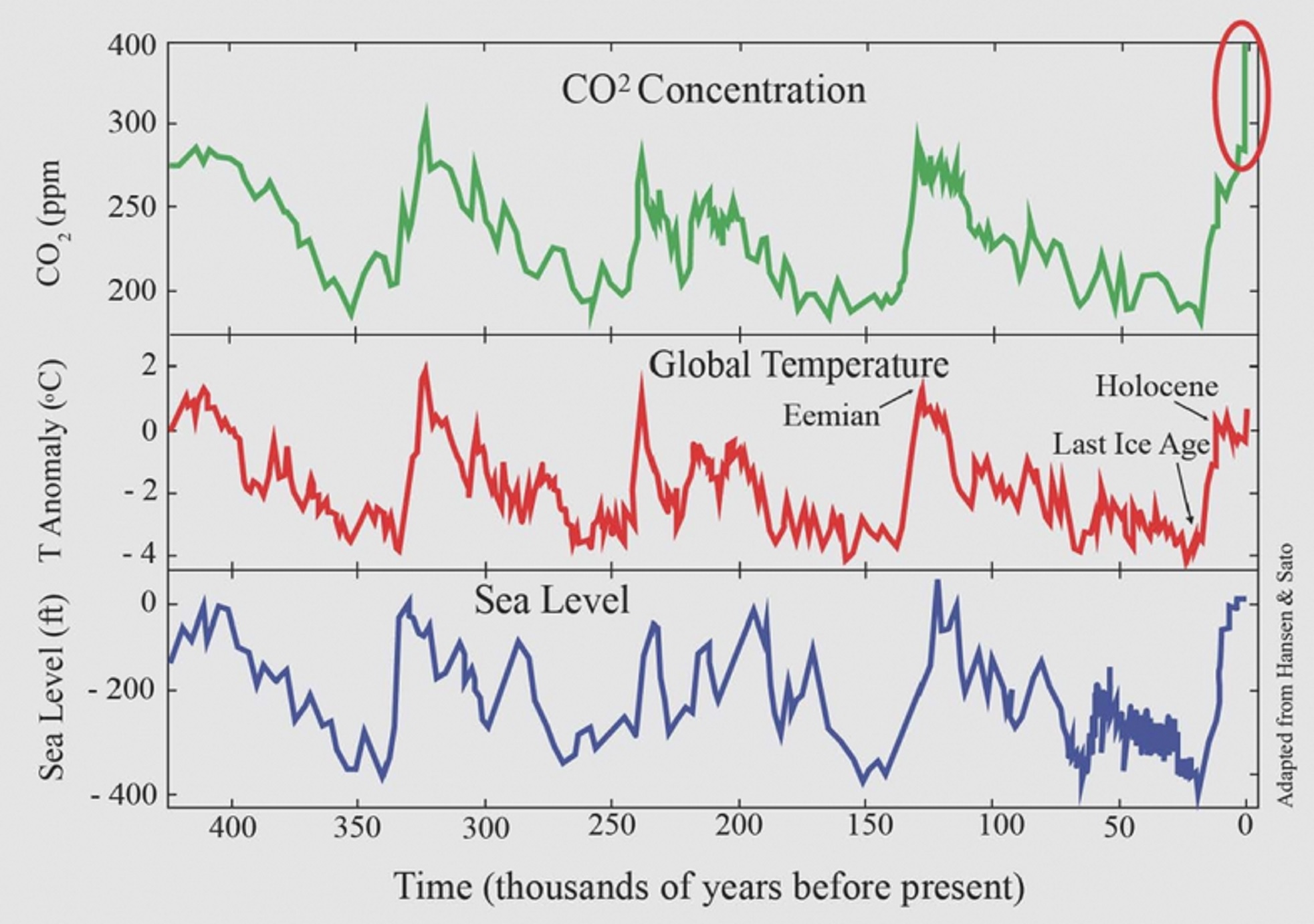
The graphs show the movement over the last 420,000 years of:
- Carbon dioxide concentrations in the air (the green line)
- Global temperatures (the red line)
- Sea levels (the blue line)
The carbon dioxide concentrations have fluctuated between about 180 and 280 parts per million (ppm) over this period of 420,000 years, but in the last 50 years, they have rocketed to above 410 ppm. (See the red circle on the green carbon dioxide graph.)
Sea levels and temperatures have moved with carbon dioxide levels in the past. This suggests that the recent increase in carbon dioxide will lead to large rises in sea level and temperature.
The graph shows five periods of high temperatures. We are living in one of those warm periods. During the previous warm period, about 120,000 years ago, the temperature was a few degrees warmer than at present, the sea level was about 8 meters higher than at present, and carbon dioxide levels were much lower than they are now.
The work of Hansen and Sato provided the basis for this graph
(John Englander: Oceanographer)
https://johnenglander.net/420000-years-of-temp-co2-and-sea-level-what-a-coincidence/
Article
The three-minute story of 800,000 years of climate change with a sting in the tail: The Conversation 13 J
Loaded 10 August 2014: Modified 20 July 2026