The Arctic sea ice is in decline.
See the latest Arctic Sea Ice graph.
In May 2026, this graph showed the ice area decreasing by 12.2 percent per decade.
This old 2014 Arctic sea ice graph below shows the decline at that time.

- This 2014 graph shows the average of the “Area covered by Arctic Sea Ice during September” each year.
- The sea ice area normally reaches a minimum in September, after its summer decrease, and as it starts its winter increase.
- The area is in millions of square kilometres.
- The decline shown in this 2014 graph is continuing.
Arctic Ice Cools the World
“Arctic ice plays an important role in maintaining the Earth’s temperature. The shiny white ice reflects light and heat that the ocean would otherwise absorb, keeping the Northern Hemisphere cool.” (NSIDC)
Arctic Ice-Albedo Heating Cycle Diagram

In this amplifying feedback cycle:
- A rise in temperatures tends to melt ice and
- Reduce the area covered by sea ice, exposing ocean water, which is far less reflective than ice, which tends to
- Reduce the sunlight reflected from the Arctic back into outer space, which tends to
- Increase the amount of the sun’s heat absorbed by the Arctic, which tends to
- Raise temperatures even more, and then the cycle repeats.
The amount of light reflected from a surface is the surface’s “albedo.” Uncovered ice reflects about 85% of incoming light and has an albedo of around 85%, whereas ocean water has an albedo of around 15%. This difference in reflectivity drives the cycle, and it’s why “albedo” is part of the cycle’s name.
The Heating Cycle is Intermittent
This ice-albedo heating cycle operates intermittently because several causal links function only under certain conditions. Consider each causal link:
- An increase in temperature tends to reduce ice cover, but only when temperatures are above freezing. When temperatures are at or below freezing, ice cover does not decrease; it remains constant or increases. This link is intermittent, causing the cycle to pause. This link is also slow because melting ice requires a lot of energy. It takes 80 calories to melt 1 gram of ice at 0°C into water at 0 °C. That is as much energy as it takes to boil tap water: to heat 20°C tap water to 100 °C.
- A reduction in ice cover tends to reduce sunlight reflection, depending on how much sunlight is available. This link operates most strongly when sunlight is strongest, in mid-summer. The link weakens in low sunlight and pauses the cycle at night because no sunlight means no reduced reflection. Again, this link is intermittent, and the pauses are lengthy in mid-winter when there is no daylight.
- Reduced reflection tends to increase heat absorption.
- More heat absorption tends to raise temperatures. For example, when seawater absorbs heat, it takes roughly 0.95 calories of energy to raise the temperature of one gram of seawater by 1°C.
This cycle is intermittent, as it stops functioning at night and whenever temperatures are below freezing, e.g., during the winter when the area covered by ice increases. (The graph near the end of this page shows the seasonal variation of ice cover.)
The heating cycle’s activity varies:
- with time at a given location, as it can be active during the day and inactive at night.
- with location at a given time, as it is often light in some parts of the Arctic while it is dark in others. So, the heating cycle can be active in sunlit areas and inactive in dark areas simultaneously.
The Ice-Albedo Cooling Cycle
An additional layer of intermittency exists, as this ice-albedo cycle is one of those amplifying cycles that can run in reverse. We have discussed heating caused by the ice-albedo cycle, but it can also cause cooling.

In this ice-albedo cooling cycle:
- A drop in temperatures tends to
- Increase the area covered by highly reflective sea ice, which tends to
- Increase the sunlight reflected from the Arctic back into outer space, which tends to
- Reduce the amount of solar heat absorbed by the Arctic, which tends to
- Drop temperatures even further, and the cycle repeats.
The cooling cycle is active only when both freezing temperatures and sunlight are present. In the past, the Earth has moved between ice ages and interglacial periods about every 100,0000 years. This ice-albedo cooling cycle helped develop and maintain ice ages. We live on a dynamic planet.
Currently, the cooling cycle only functions briefly. Overall, the ice-albedo heating cycle dominates, with temperatures rising and sea ice area declining.
Dominant despite inactivity and reversal
An amplifying feedback cycle is dominant over a period if, from the start to the end of the period, each change encouraged by the cycle has occurred.
The Arctic ice-albedo heating cycle is dominant over a period when:
- Average air temperatures have increased,
- The ice cover has decreased, and
This cycle has been dominant over the last forty years, despite the cycle moving between being:
- Active, e.g., on days when the temperatures are above freezing and ice cover is decreasing, allowing the Arctic to absorb more heat from the sun,
- Inactive, e.g., at night when there is no sunlight to reflect, and
- Running in reverse, e.g., on days when temperatures are low and ice cover is increasing, allowing the Arctic to absorb less heat from the sun.
The heating cycle has been dominant, supported by other global-warming-amplifying cycles and by humans adding greenhouse gases to the atmosphere. Over this period, (1) Arctic sea ice cover has dropped (see the above graph), and (2) the Arctic has warmed twice as fast as the rest of the globe.
A dangerous spiral is occurring in the Arctic, with warming causing further warming.
Limiting the heating cycle
Humans could limit this vicious cycle, or it could simply run its course:
- Lowering temperatures: Humans might be able to reduce Arctic temperatures by reducing atmospheric greenhouse gas levels. This reduction could allow more heat to escape from the planet, cool the Arctic, and pause the melting cycle.
- Reducing the Arctic’s absorption of sunlight: Nature might do this with massive volcanic eruptions that darkened the globe for extended periods. Humans could theoretically attempt this through large-scale geoengineering that shaded the Arctic: an immense endeavour.
- Exhausting a necessary resource: Arctic ice. If humans do not stop this vicious cycle, it could continue until it ultimately melts all the ice, leading to an ice-free period during the summers. Ice-free summers would significantly affect the global climate, as the Arctic would reflect far less sunlight and the planet would lose an important cooling mechanism.
Arctic Sea Ice Area: Daily graph
You can see the movement of “sea ice cover” over a year, for each year since 1979. The graph for the current year updates each day, often showing that this year’s ice cover is below the record minimum.
The latest daily “Arctic Ice Area” graphs are on the “US National Snow and Ice Data Centre” (NSIDC) web page.
Here is a photo of this interactive web page on 6 April 2015.
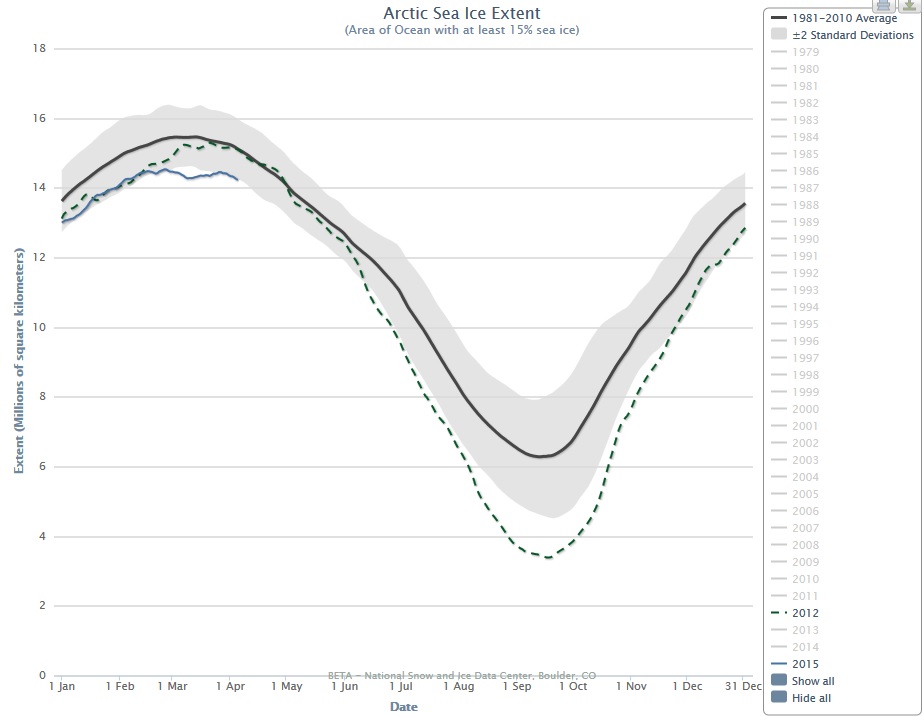
- The graph shows Arctic Sea Ice Extent: the area with more than 15% sea ice, measured in “millions of square kilometres”.
- The dotted green line shows the sea ice area for each day of the record-low year of 2012. The sea ice area was greatest in mid-March 2012. It was lowest in mid-September.
- The blue line from 1 January to 5 April 2015 shows the 2015 ice cover. The 2015 line ends on 5 April, as I took the photo on 6 April.
- The thick black line is the average extent for each calendar day from 1981 to 2010
- The grey area on the graph shows two standard deviations on either side of the average.
- The online NSIDC graph is interactive; e.g., you can click any year in the list on the right to see how ice cover changed that year.
Wind up
The ice albedo heating cycle shows that:
- Simple cyclic causal linkages can produce powerful change.
- Amplifying feedback cycles can generate long-term change as they move between functioning, non-functioning, and even reversing.
- Unimpeded, this heating ice-albedo cycle will persist until it exhausts a critical resource, sea ice, and becomes self-limiting.
- Amplifying feedback cycles can be intermittent.
In today’s Arctic, the evidence is unambiguous. Declining ice cover and rising temperatures indicate that the heating ice-albedo amplifying feedback cycle is dominant overall.
References
A regime shift is taking place as the Arctic sea ice melts (ABC: 13 Jan 2021)
Arctic sea-ice loss accelerates Arctic warming: Scientific American: 2010
Links to the three Hub Pages are in the footer below and in the menu above.
Loaded 10 August 2014; Modified 16 July 2026.
Featured Image: Ice cover graph