Sea levels are rising
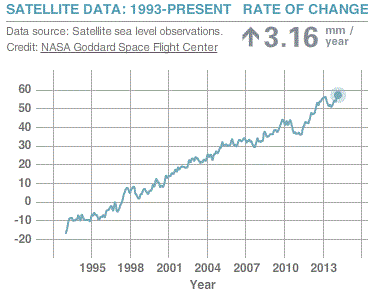
- The blue line shows how sea level rose between 1993 and 2014.
- This rise has continued.
- A rise of 3.16 mm per year may not sound like much – but the ocean covers about 70 percent of Earth’s surface. A 3.16 mm rise is an enormous amount of water.
- The sea-level drop in 2011 was due to Australia’s 2010 / 2011 floods. Extreme rains dumped vast amounts of water onto Australia. The decrease was temporary as this water evaporated and returned to the sea.
The Latest Sea Level Graph shows that sea levels continue to rise. (Click on “Learn more” under the “Sea Level” graph)
This Climate Dot US website reproduces trusted climate information that was once available on US government websites. The Trump administration fired climate scientists and trashed these government sites. These scientists created this website
Sea levels are rising faster
- The sea level rose 1.7 mm a year between 1870 and 2000
- The sea level was rising at 3.2 mm a year in 2018
- The rate of sea level rise has almost doubled.
Sea level rise is the yardstick for global warming (NASA).
NASA states that sea level rise is the yardstick for global warming.
This NASA statement means that the steep upward trend in the sea level graph is strong evidence of rising global temperatures and global warming.
Sea levels are rising due to ice melting
The rising heat is melting ice in places like Antarctica and Greenland; the meltwater runs into the ocean, raising sea levels.
Sea levels are also rising due to ocean warming
- Water expands as it warms, like mercury in a thermometer.
- In a mercury thermometer, when the mercury warms, it expands, moves up the calibrated scale, and we can read the temperature on the scale.

- As the ocean warms, its water expands, increasing sea levels and acting as a sort of thermometer.
Our oceans are absorbing the heat
- The oceans absorb over 90% of the heat our planet gains because greenhouse gases in our atmosphere prevent the heat from escaping back into space.
- The atmosphere and the ground absorb only about 5% of this heat accumulation.
Dangers
Rising sea levels are already a problem
- Rising sea levels are already causing problems in low-lying coastal areas.
- The Intergovernmental Panel on Climate Change (IPCC) projects that sea levels will rise by between 0.18 and 0.6 meters (7 inches and 2 feet) between 1990 and 2100.
Potential climate refugees: Bangladesh
- The population of Bangladesh is 157 million.
- About half of them live less than 5 meters (16.5 feet) above sea level.
- In 1995, the sea half-submerged Bangladesh’s Bhola Island, leaving 500,000 people homeless.
- Scientists predict Bangladesh will lose 17 percent of its land by 2050 due to flooding caused by climate change.
- The loss of land could lead to as many as 20 million climate refugees from Bangladesh.”
- Climate change could significantly increase the number of refugees seeking refuge in places like Australia.
- Inaction on climate is kick-starting the boats and boatloads of climate refugees.
(National Geographic Society: Encyclopaedia: Climate Refugees)
(now a broken link) http://education.nationalgeographic.com.au/education/encyclopedia/climate-refugee/
Climate change risks to the Australian coast
By 2100, rising sea levels may threaten up to 247,000 residential buildings in Australia. The cost of replacing them would be $63 billion, valued at 2008 prices.
- Australian Government: National Assessment of Climate Risks to Australia’s Coasts (2009)
Rising Sea a Billion Dollar Threat (The Age, 16 Dec 2010, p 7)
Eventual sea level rise could be 66 meters
If we
Sea levels are slowly, steadily increasing. This rise is dangerous, as without effective climate action, levels will eventually rise by tens of meters, causing widespread devastation.
(Warming oceans are making the climate crisis significantly worse: Eos: American Geophysical Union: 19 Apr 2021)
Loaded 2014; Modified 5 July 2026.