This page sets out ten vicious cycles that are accelerating current global warming. In many of these circular chains of cause and effect, rising temperatures trigger changes that further raise temperatures.
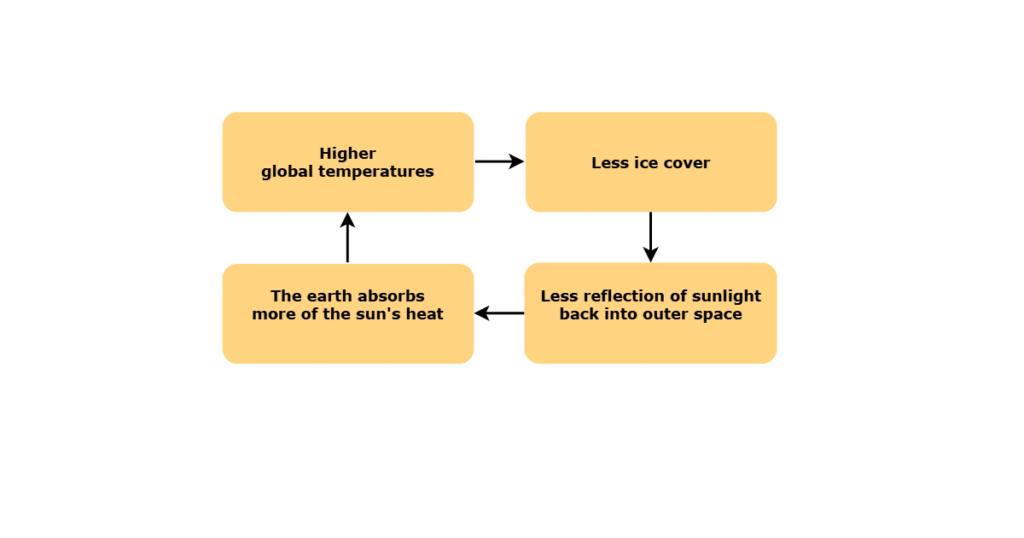
The Arctic Ice-Albedo Warming Feedback
Here is the first vicious cycle.

See the dwindling Arctic sea ice page on this website.
- The Arctic Ice-Albedo Warming Feedback
- Climate change and hoax
- The Permafrost Feedback
- The Forest Fire Feedback
- The Water Vapour Feedback
- The Phytoplankton Feedback
- The Ocean CO2 Feedback
- The Ice Darkening Feedback
- The Glacier Thinning Feedback
- The Populist Politics Feedback
- The Climate Change Denial Cycle
- Other Warming Feedback Cycles
- No Evidence of Any Dynamic to Stop the Warming
- The Danger of Global Warming Amplification
- The amplification of climate action
Climate change and hoax
Here are some questions for people who say that climate change is a hoax:
- What climate mechanism will counteract the feedback cycles driving climate change?
- When will this mechanism begin to slow the current warming trends shown on this site’s evidence page?
- We have wide-ranging evidence that human emissions are driving climate change. What evidence do you have that climate change is a hoax?
The Permafrost Feedback

For more, see the permafrost feedback cycle on this website.
The Forest Fire Feedback

See my page on fires intensifying climate change.
The Water Vapour Feedback

In this amplifying feedback cycle:
- Increased global air temperatures tend to
- Increase (a) the air’s capacity to hold water vapour, and (b) evaporation from the oceans, which tends to
- Increase water vapour (a greenhouse gas) in the air, which tends to
- Increase greenhouse heating, which tends to
- Increase global air temperatures, and then the cycle repeats.
This feedback is fast-moving because an increase in air temperature immediately increases the amount of water vapour the air can hold.
This cycle is also reversible, as global cooling would reduce atmospheric water vapour, but we are far from seeing any global cooling.
(Climate Change: Now or Never: New Scientist: 24 Apr 2021: page 37).
The Phytoplankton Feedback

See my page on Ocean surface heating and the phytoplankton feedback cycle.
The Ocean CO2 Feedback

See my “Temperature & Carbon Dioxide” page.
The Ice Darkening Feedback

In this amplifying feedback cycle:
- Higher temperatures tend to
- Melt more of the ice sheet, which tends to
- Expose more dark matter on the ice surface, like ash from distant bushfires that landed on the ice long ago and became buried within the ice, which tends to
- Reduce the reflection of sunlight from the ice back into outer space, and increase the sunlight absorbed, which tends to cause
- Higher global temperatures, and then the cycle repeats.
The Glacier Thinning Feedback

This feedback occurs because average temperatures at high altitudes are much lower than at sea level, and some Antarctic ice sheets are over 4,000 metres high.
See the Glaciers in Retreat page on this website.
The Populist Politics Feedback
Here is a climate-political feedback cycle that could take hold.

A powerful way to limit mass migration is to curb climate change and its disruptions.
See the right-wing populism feedback cycle on this website.
The Climate Change Denial Cycle

See the climate change denial cycle on this website
Other Warming Feedback Cycles
Lovelock (2006, p. 34) mentions three additional warming feedback cycles related to forests, and there will be even more.
No Evidence of Any Dynamic to Stop the Warming
James Lovelock (The Revenge of Gaia, 2006, page 35) writes that global warming is a grave concern. The current rate of warming suggests that there are no global climate dynamics that will:
- Effectively oppose this warming,
- Limit temperature increases, and
- Keep the environment safe for life as we know it.
Lovelock points out that methane and CO2 levels in the atmosphere in 2006 were comparable to those from natural releases of these gases 55 million years ago. At this time, temperatures rose by 5 to 8 degrees Celsius, with consequences lasting 200,000 years.
There is no evidence of any climate dynamic that will stop the current global warming.
The Danger of Global Warming Amplification
Feedback cycles start slowly but then can produce rapid change. Unfortunately, the above global heating feedback cycles reinforce one another, each adding to the heating and threatening our nurturing climate. A critical danger is that:
- One of these heating feedback cycles becomes dominant.
- This dominance triggers a cascade in which other heating feedback cycles become dominant.
- Humans cannot counter this heating because (1) stopping the use of fossil fuels only stops one source of carbon dioxide and does not decrease the levels of greenhouse gases in the atmosphere, and (2) geoengineering to cool the planet does not match the heating of the heating feedback cycles.
- The heating destroys our nurturing environment.
We have co-evolved with our climate, so our current climate system suits human beings and the rich diversity of life on our planet. We must protect our climate system because global heating threatens our current climate, the global economy, political stability, human health, mass migration, and the environment.
The amplification of climate action
These vicious cycles driving global warming are frightening. So, I have included (1) a positive section here about Australia’s progress towards electrification, and (2) a virtuous cycle that could amplify effective action in Australia to inhibit global warming.

In this cycle:
- An increase in the popularity of the “Australia as a renewable energy superpower” vision tends to
- Increase progress towards that vision, which tends to
- Increase the resulting benefits, which tends to
- Increase the popularity of the superpower vision, and then the cycle repeats.
Focusing on the feedback cycles that amplify global heating can be demoralising. It can be more energising to focus on positives, like this “amplification of climate action feedback”, which could propel Australia towards an attractive future. For more on this, see:
- The amplifying feedback cycle of vision, progress & benefit on this website, and
- Australia’s progress towards being a renewable energy superpower on this website.
Related pages
Feedback is a long-established concept central to “Systems Theory”. See my page on:
Scientific certainty increases as evidence from different sources converges on one result. We have an overwhelming convergence of evidence supporting climate change. See my page on:
Hub Pages: See the Footer below for links to the three hub pages, or the menu at the top of the page.
External Links re feedback
- Climate Change Feedbacks: 10-minute video: UK Meteorological Office
- Feedback loops point to a very hot 21st Century: Science Daily, 6 May 2006
- Greenland Reels: Climate Disrupting Feedbacks Have Begun: Truth-Out: 5 March 2015
Featured image: Ice albedo warming cycle.
Links to other pages
Hub Pages: See the Footer below for links to the three hub pages, or the menu at the top of the page.
Loaded 2014. Updated 6 September 2026.